
Two rafts, one current that still runs
A simultaneous read of “Huck Finn” and “James,” and a boatload of inspiration
By and by, I finished a two-book odyssey: Mark Twain's “Adventures of Huckleberry Finn” and Percival Everett’s “James” read in tandem, 140 years apart.
The trip spans American literary and cultural history from 1885 to present. Twain gave us a foundational novel. Everett gave it a rebuttal worthy of the same shelf.
I made the crossing solo, on my own clock. Fitting, for two novels about people charting their own course.
Same river, different captain
Everett largely follows Twain’s map. The milestones hold: the hideout on Jackson’s Island, the storm, the slave hunters, leaky watercraft and a pair of predatory con men.
Read in tandem, the chapters rhyme: Twain hands Huck a quill; Everett hands a pencil to the man Huck spent the whole first book misreading. Same events, opposite vantage points. Scenes I had read hours or days earlier had new dimensions.
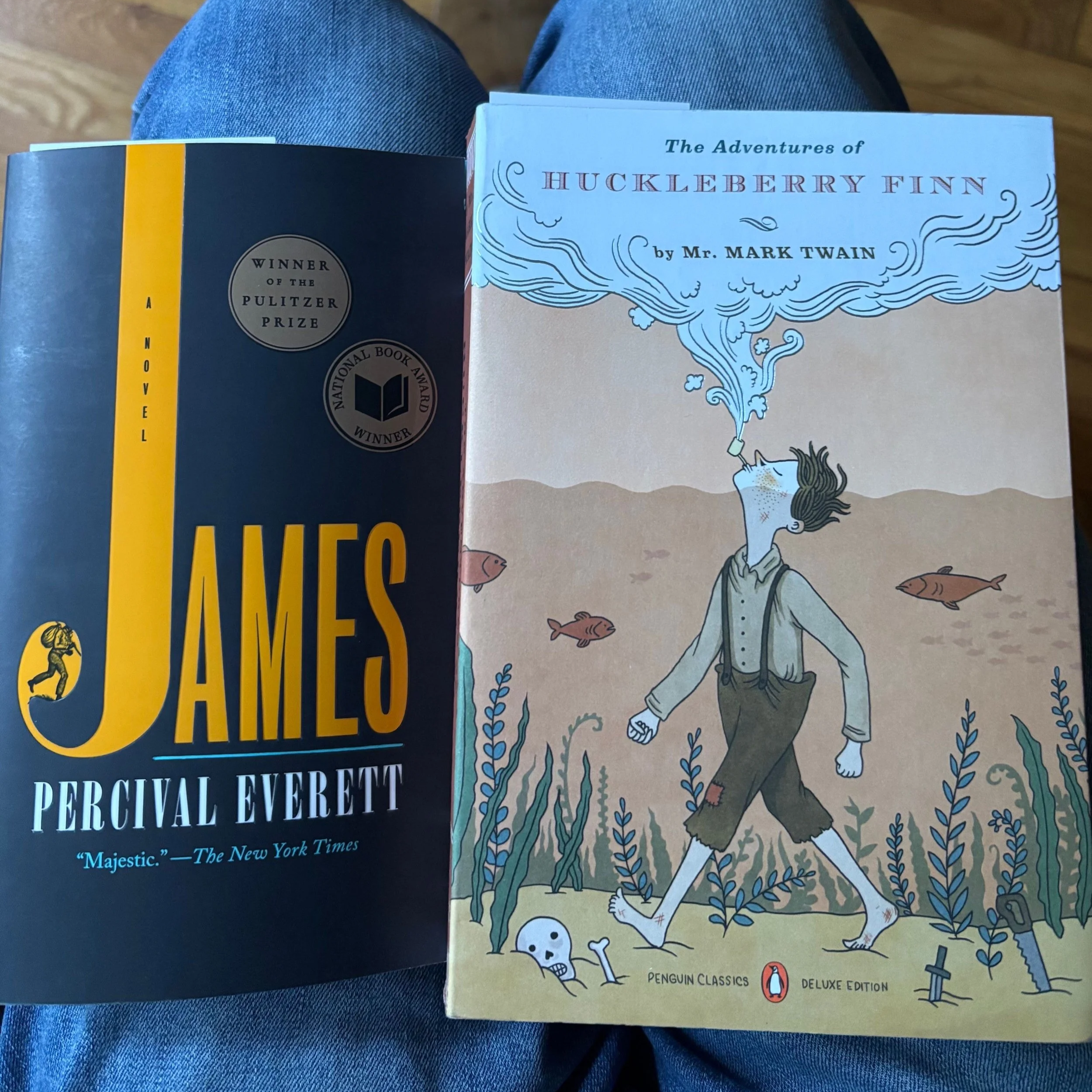
Day one of the journey
Then Everett flips the mechanics: Jim’s path to freedom runs on a wholly-original engine, and its meaning shifts toward linguistic autonomy, true selfhood and conscious rebellion. In his hands, emancipation means total emancipation: body, mind and voice.
The “slave filter”
Everett’s Jim code-switches. Around white folks, he speaks the dialect they expect. Among his people, and inside his head, he speaks with precision and wit.
He even teaches it. Early on, Jim coaches enslaved children in the art of sounding the way white people need them to sound. Safety, it turns out, depends on grammar.
That filter drives the novel’s strangest side quest. Jim falls in with a runaway who passes as white, then gets pressed into a minstrel troupe: forced into blackface to play a white man’s caricature of himself. Surreal barely covers it.
Agency becomes Jim’s crowning achievement. The secretly literate, deeply philosophical man behind the mask claims his own name and his own story. One line says it all:
| “With my pencil, I wrote myself into being.”
Twain’s satire at full tilt
Twain never runs short on farce. Early on, Tom Sawyer’s robber-gang games mock a rural, churchgoing white society that romanticizes European feudalism and homegrown chivalry while ignoring the brutality of slavery in its own yard.
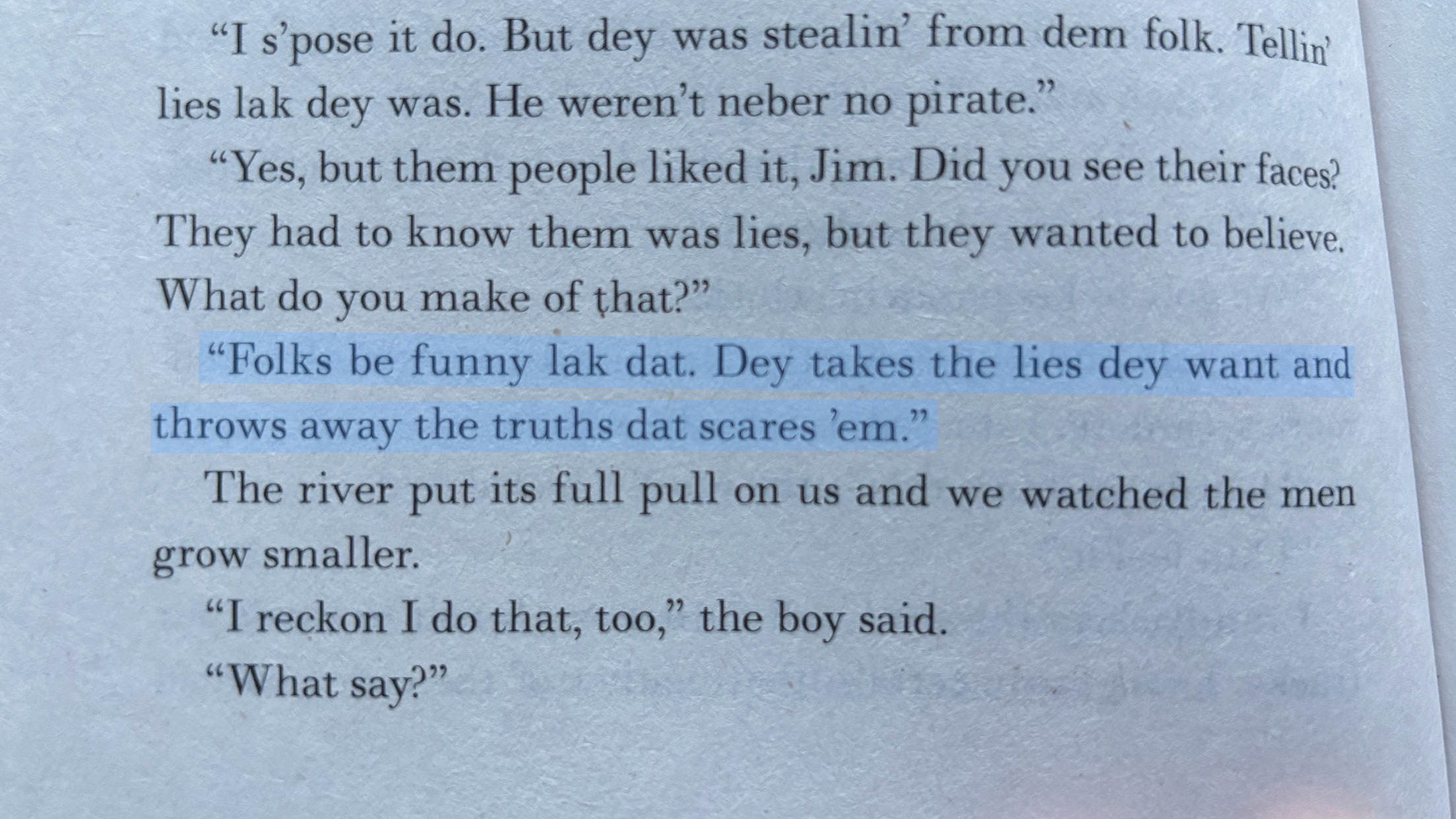
James’ veracious individuality on full display
The climactic reunion of Huck and Tom tops it all. Tom stages an elaborate prison break, plucked from adventure novels, to rescue a Jim who is already legally free. It’s satire at a pitch only Twain’s early comic alter ego, Thomas Jefferson Snodgrass, could hit.
Everett plants new twists of his own: one inside a derelict house the river swallows during a storm, another in what truly binds Huck and Jim. No spoilers!
Truths that outlive their timestamps
Both novels hold a mirror to "civilized society" and catch it lying. Western democratic philosophy promised liberty. America in the decades before the Civil War bent that promise into a hierarchy that excluded and commoditized enslaved Africans.
For Huck, the collision sparks a moral crisis. He believes the church’s teaching that helping Jim escape is a sin, and he chooses Jim anyway:
| “All right, then, I'll go to hell.”
A boy picks damnation over betrayal, and his conscience outvotes the society to which he belongs.
James reaches his reckoning in a fever dream. Delirious, he spars with Voltaire and John Locke and calls them out: civil liberties pervert natural liberty, and their abstract theories of “freedom” give the powerful and privileged cover to ignore, or justify, inhumane treatment of others.
Still on the river
Those truths outlive any publication date. The clash between individual conscience and socialized morality still grips anyone pushing for climate action, anyone outraged by America’s treatment of immigrants, or anyone opposed to the unlawful war the U.S. and Israel waged on Iran.
Like Huck and Jim, they grapple with the existential necessity of self-determination, especially where physical freedom and internal liberation pull in different directions.
Notes from a crew of one
The stakes bear no comparison. Jim risks his life and his family; I risk a slow quarter. Still, the truths travel and land squarely on anyone who works for themselves.
Self-determination is the solopreneur’s daily practice. Nobody hands you a title, a brand or a voice. You forge them yourself: one proposal, one post, one deck at a time. Every blank page is a chance to write yourself into being.
Conscience versus conformity shows up at work, too. Every industry runs on its own socialized morality: the growth-at-all-costs playbook, the deck that buries the inconvenient slide. Going solo forces a choice Huck would recognize. Your name sits on the outcome either way.
And physical freedom differs from internal liberation. Leaving the org chart buys the first. The second takes longer: trusting your own judgment once nobody else signs off on it.
Huck lights out for the Territory. James writes himself into being.
Twain drew the map. Everett redrew it. Read them together, and 140 years of American history fit on one raft.
